The Reserve Bank lifted the cash rate to 4.85% on 3 November 2026, its fifth rise this year. At the same time, CreditorWatch’s September figures show fewer than half of all invoices are being paid on time, and one in ten is more than 60 days late, the highest since April 2018.
Money costs more, and it’s arriving later. That combination is how a business that looks fine on paper runs out of cash.
You don’t need a 40-page report to see it coming. Five numbers, checked once a month, show you where the pressure is and what to fix first. This guide works through all five using one example business, with the formula, where to find it, and the level at which to worry. The click paths are for Xero, but the reports have the same or very similar names in MYOB and QuickBooks.
Key takeaways
- Your bank balance is not your cash. Take out GST, wages, super and the bills you already owe, and work out how many days the rest covers.
- Revenue only means something against the same month last year, split into number of sales and average sale.
- Gross margin moves quietly. Three points on $60,000 of monthly sales is $21,600 a year.
- Profit before the owner is paid is not profit.
- Count how many days customers take to pay you, not just how much they owe.
The example: a café turning over $720,000 a year
One made-up business runs through this whole guide: a café with a corporate catering arm, turning over about $60,000 a month. Most sales are over the counter. About $15,000 a month is catering, invoiced on 14-day terms. It has a $250,000 variable-rate loan from its fit-out.
Here is its October, next to October last year.
| October this year | October last year | |
|---|---|---|
| Revenue | $60,000 | $57,500 |
| Cost of sales (coffee, milk, food, packaging) | $22,800 | $20,125 |
| Gross profit | $37,200 (62%) | $37,375 (65%) |
| Running costs (wages, rent, everything else) | $33,000 | $31,600 |
| Net profit | $4,200 (7%) | $5,775 (10%) |
| Bank balance at month end | $50,000 |
Sales are up $2,500 and the bank balance looks healthy. Most owners would stop there. The five numbers tell a different story.
1. Cash you can actually use
What it is. Your bank balance, less the money in it that already belongs to someone else.
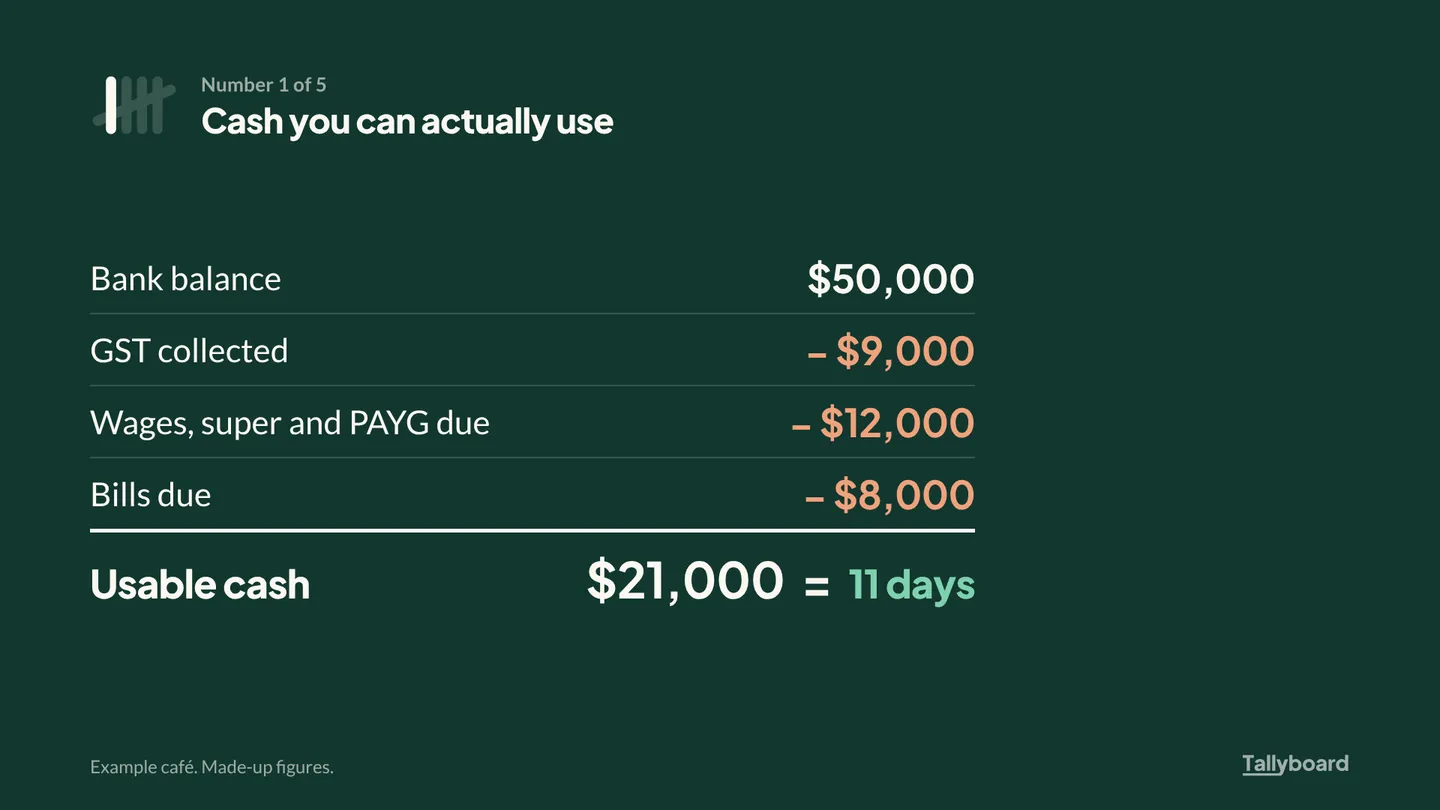
How to work it out. Bank balance, minus GST collected and not yet paid, minus wages, super and PAYG due, minus supplier bills you’ve received and haven’t paid. Then divide what’s left by your costs per day. That gives you cash days: how long the business could run if no money came in.
Why those three. They are what the business already owes today, so that money isn’t yours even though it’s in your account. Bills that haven’t arrived yet aren’t taken out, because they’re part of the daily cost you divide by. Taking them out here as well would count them twice.
Where to find it in Xero. Run the Balance Sheet as at today and read four lines under liabilities: GST, PAYG Withholdings Payable, Superannuation Payable and Wages Payable. Then run the Aged Payables Summary. Its total is the bills you’ve received and haven’t paid.
The café. $50,000 in the bank. $9,000 of it is GST. $12,000 is wages, super and PAYG due next week. $8,000 is supplier bills received and not yet paid. That leaves $21,000. The café spends $55,800 a month, or about $1,860 a day. So $21,000 is 11 days of costs, not the month or so the bank balance suggested.
The line to watch. A common rule of thumb is two to three months of costs in reserve. If that feels out of reach, make one month the first target. Under 30 days, check this number weekly, not monthly.
Rate rises land here first. Five rises since February have added 1.25 percentage points. On the café’s $250,000 loan, if the lender has passed all of it on, that is about $3,125 a year more in interest, or $260 a month. Find the rate on your own loan today and put the new repayment in your budget.
Try it with your own numbers. The starting figures are the café’s.
Usable cash calculator
How much of a bank balance is really yours, and how long it lasts. These are the example café's figures. Change any of them.
General education only, using the figures you enter.
2. Revenue, against the same month last year
What it is. Everything you sold or invoiced in the month.
How to read it. Never on its own, and not against last month, because seasons distort it. Compare it with the same month last year. Then split it in two: number of sales, and average sale. Your point-of-sale system or invoice list has both.
Where to find it in Xero. Open the Profit and Loss, set the date range to last month, and add a comparison period for the same month last year.
The café. Revenue is up 4.3%. But last October the café made about 7,900 sales averaging $7.28. This October it made about 7,600 sales averaging $7.89. Revenue grew only because prices did. Three hundred fewer sales came through the door.
The line to watch. If revenue growth is below the rate your own prices went up, you are selling less. That is worth knowing months before it shows up as a bad quarter.
3. Gross margin
What it is. The share of each sale left after the direct cost of making it: stock, ingredients, materials, packaging, subcontractors.
How to work it out. Gross profit ÷ revenue. For the café, $37,200 ÷ $60,000 = 62%.
Where to find it in Xero. The Gross Profit line on the Profit and Loss. If you don’t have one, your direct costs are mixed in with your running costs, and fixing that in your chart of accounts is the first job.
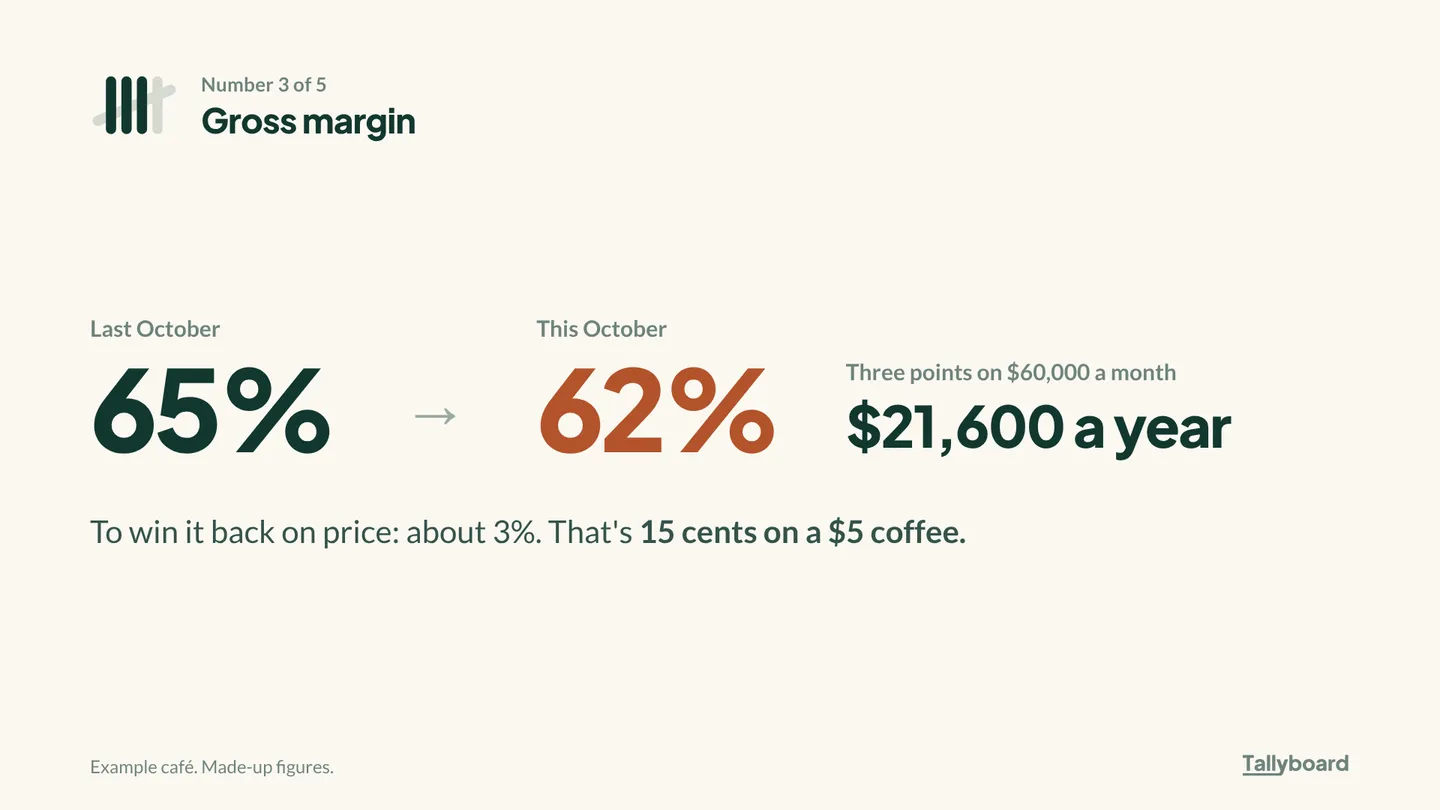
The café. Margin has slipped from 65% to 62%. Three points sounds small. On $60,000 a month it is $1,800 a month, or $21,600 a year. It’s the reason gross profit went down in dollars while sales went up.
The line to watch. A move of more than a point or two, in either direction, needs an explanation. You can also compare yourself with your industry. The ATO publishes benchmarks for about 100 industries from tax return data. For coffee shops turning over more than $600,000, cost of sales runs from 33% to 38% of turnover, averaging 36% (ATO small business benchmarks, 2023–24). The café’s 38% puts it at the top of that range.
What to do about it. Check four things, in this order: supplier prices on the last three invoices against the same ones a year ago, wastage, discounts and staff meals, and whether the sales mix has shifted to lower-margin items. To win back $1,800 a month through price alone takes a rise of about 3%, if the number of sales holds. That is 15 cents on a $5 coffee.
Surcharges on debit and credit cards ended on 1 October 2026. If you used to pass the card fee on, it now comes out of your profit. Merchant fees are usually recorded as a running cost, not a cost of sales, so the change will show up in number 4, not here. Find the line and look at October against September.
4. Net profit, after you’ve been paid
What it is. What’s left after every cost. The bottom line of the Profit and Loss.
How to read it. In dollars and as a percentage of revenue. The café made $4,200, or 7%, down from $5,775 and 10% a year ago. Sales rose $2,500 and profit fell $1,575.
The check most owners skip. Is your own pay in there? If you run as a sole trader or partnership, or take drawings from a company in place of a wage, your pay never appears as an expense. The profit figure then includes the wage you should have been paid. Take a fair wage for your hours off the bottom line before you call what’s left profit. If the café owner works 50 hours a week and isn’t on the payroll, $4,200 is not a profit. It’s a low wage.
The line to watch. Ask one question: if every month looked like this one, would I be comfortable? The ATO’s benchmark for coffee shops of this size has total expenses at 86% to 93% of turnover. The café is at 93%.
Remember that profit isn’t cash. Loan repayments, stock you haven’t sold and money you take out don’t appear as expenses, which is why number 1 comes first.
To see how many sales you need each month just to cover your costs:
Break-even calculator
How many sales a month cover your costs? Use amounts excluding GST.
General education only, using the figures you enter. Direct costs are the costs of making each sale, such as stock, materials or merchant fees.
5. Money owed to you, in days
What it is. Unpaid invoices, and how long customers are really taking to pay.
How to work it out. Debtor days = money owed to you ÷ invoiced sales for the month × 30.
Where to find it in Xero. The Aged Receivables Summary lists what each customer owes, split by how overdue it is.
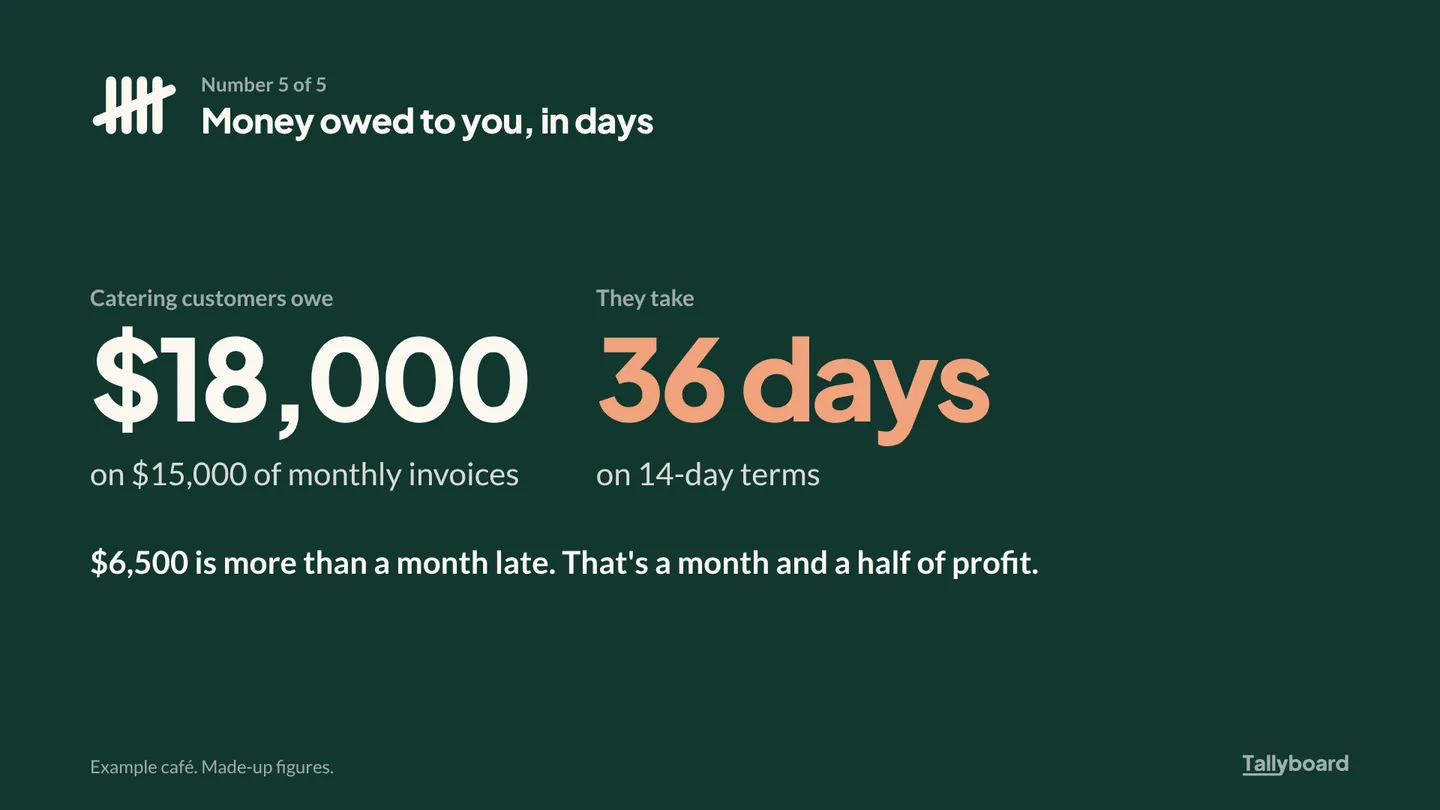
The café. Catering customers owe $18,000 against $15,000 of monthly catering sales. That is 36 days, on 14-day terms. Of the $18,000, $6,500 is more than 30 days overdue and $2,400 is more than 60. The $6,500 alone is more than a month and a half of the café’s profit, sitting in other people’s bank accounts.
The line to watch. Debtor days more than double your payment terms, or anything over 60 days.
What to do about it.
- Call the three largest overdue accounts this week. A call gets paid before an email does.
- Turn on automatic invoice reminders. In Xero, open the Invoices screen and choose Invoice reminders. The default schedule sends them at 7, 14 and 21 days overdue.
- For new work, shorten your terms or take a deposit. It’s easier to set terms before a job than to chase after it.
What the five numbers say together
Read alone, each number is a fact. Read together, they give you an order of work. Here is the café’s.
| Number | Reading | What it means |
|---|---|---|
| Usable cash | $21,000, or 11 days | Thin. One late catering payment causes a problem. |
| Revenue | Up 4.3%, on 300 fewer sales | Prices are carrying it. |
| Gross margin | 62%, down from 65% | $21,600 a year has leaked. |
| Net profit | $4,200, or 7% | Before the owner’s pay. |
| Money owed | $18,000, 36 days | $6,500 is more than a month late. |
The order is cash first, because it’s fastest: collecting the $6,500 adds more than three days of cover this week. Margin is second, because it’s the biggest prize. The loan and the buffer come after that.
Three things that make these numbers lie
- Books that aren’t reconciled. If last month’s bank transactions aren’t matched, every number above is wrong. Reconcile first, then read.
- Stock expensed when it’s bought. A big order in one month drags that month’s margin down and flatters the next. If your margin jumps around, look at a three-month average.
- Mixing cash and accrual. Xero can show the Profit and Loss either way. Accrual counts a sale when you invoice it, cash when you’re paid. Pick one and stay on it, or your months won’t compare.
The 15-minute routine
- Put a repeating 15-minute block in your calendar for a fixed day each month, such as the 10th, once last month is reconciled.
- Save the four reports as favourites so each is one click: Balance Sheet, Aged Payables, Profit and Loss, Aged Receivables.
- Let the software keep the history. Set the Profit and Loss to show the last 12 months side by side, and the trend in revenue, gross margin and net profit is on one screen with nothing to type. Usable cash and debtor days are the only two that need a quick sum.
- When a number moves more than you expected, find out why before next month. That’s the whole job.
After three months you’ll have a trend. After twelve you’ll know your business better than most owners ever do. That’s what it means to always know the score.
Frequently asked questions
How often should I check these numbers?
Monthly for all five, on the same day each month. Check usable cash weekly if you have less than 30 days of costs covered.
What is a good gross margin?
It depends on the industry. A café and a consultancy are nothing alike. Compare against your own last twelve months first, then against the ATO’s small business benchmarks for your industry.
Why doesn’t my profit match my bank balance?
Because some money leaves without being an expense: loan repayments, stock you haven’t sold, equipment, GST, and what you take out. And on an accrual basis, some sales count as income before you’ve been paid for them.
What if my books aren’t up to date?
Then start there. These numbers are only as good as the bookkeeping underneath them. Getting the last three months reconciled is worth more than any report.
This guide is general information only, not personal financial or tax advice. The café is a made-up example. Sources are linked where each figure appears: the Reserve Bank of Australia, CreditorWatch, Treasury and the ATO.
General information only, not advice about your particular situation. If you're unsure how this applies to you, talk to your accountant or a registered tax or BAS agent.